找回密码
 注册
查看: 112|回复: 7

K2 USB-C Meter Download Manuals Firmware PC software(11/25)

[复制链接]

31

主题

80

回帖

3109

积分

Administrator

积分
3109
发表于: 03-11-2025 06:59:29
| 显示全部楼层 |阅读模式
K2 USB-C Voltage and Current Meter User Manua
K2forum.png
US  https://www.amazon.com/dp/B0FZWGRLNT
DE  https://www.amazon.de/dp/B0FZWGRLNT
JP   https://www.amazon.co.jp/dp/B0FZWGRLNT
K2 Overview
  • RTOS real-time operating system + WIUI human-machine interface
  • 32-bit high-speed CPU
  • Independent 16-bit high-precision ADC sampling chip
  • Standalone electronic storage for data logging, retains data on power-off
  • High-speed sampling with fast refresh rate
  • 24P pass-through high-current, high-conductivity USB-C terminals

  • Do NOT connect HID power during PD measurement, as K2 requires multiple restarts for accurate detection.


K2 Features
  • PD3.1 support – 28V EPR and AVS protocol triggering
  • Supports detection and triggering of multiple fast-charging protocols
  • Unified 4D interface – WIOS + WIUI + PC
  • 240 MHz ultra-high-speed M4F 32-bit CPU with FPU hardware acceleration
  • Independent ADC sampling + on-chip 2 MHz high-speed AD
  • Spectrum analysis – simultaneously track charger ripple and frequency characteristics
  • Built-in capacity calculation
  • Built-in gravity sensor – supports automatic screen rotation


K2 Specifications
Voltage Measurement:
  • DC 3.3–48 V (K2-237)
  • DC 3.3–36 V (K2-226)
  • Voltage Resolution: 0.0001 V

Current Measurement:
  • Measurement Range: 6 A (10 A short-term peak)
  • Current Resolution: 0.0001 A (bidirectional)
  • 6 A for continuous operation
  • 10 A not recommended for more than 2 min

Capacity Recording:
  • 0–99999 Ah
  • 0–99999 Wh

CPU:
  • ARM M4F 240 MHz, 32-bit high-speed, with FPU hardware acceleration

Display:
  • 1.54-inch color IPS LCD, 240×240 resolution, wide viewing angle

Sensors:
  • 3-axis gravity sensor (for auto screen rotation)

Core ADC:
  • Independent 16-bit ADC chip (INA226: 36 V, INA237: 48 V)
  • On-chip high-speed ADC: 2 MHz
  • Low-resistance shunt resistor (high-side sampling) with anti-common-ground interference

Interfaces:
  • 24P USB-C male/female pass-through
  • External sensor: NTC temperature probe -20 °C to +120 °C (via special Type-C interface)

Storage & Firmware:
  • EEPROM with wear leveling
  • Firmware upgrade: USB HID (driver-free, via dedicated USB-C HID interface)
  • PC connection for curve plotting: HID software (USB-C HID, driver-free)

Identification:
  • VIP Code: unique serial number

High-Speed Waveform Sampling:
  • Up to 2 MHz
  • Ripple analysis: simultaneously display frequency data and ripple values

Dimensions:
  • Approx. 36.0 × 33.7 × 9.3 mm (excluding USB-C male connector)


NOTE:The software prompts that the runtime library is missing. Please install the .NET Core runtime first.
Runtime library download (win7, win10, win11 32/64 bit common) install x86, don't install 64


K2_Firmware_V4.6.zip

417.15 KB, 下载次数: 17

K2 C5 C4 C4L USB Multimeter PC Software 3.1.zip

10.98 MB, 下载次数: 16

WITRN_USBMeterUP_V26.zip

1.63 MB, 下载次数: 16

回复

使用道具 举报

31

主题

80

回帖

3109

积分

Administrator

积分
3109
 楼主| 发表于: 03-11-2025 07:03:40
| 显示全部楼层
The system is continuously updated.
Images and descriptions may differ from the actual product; the actual product shall prevail.


K2pressk4.png
Press “+” to activate the PD charger and turn on the screen.
“Warning: Do NOT power on by pressing the OK button (detection or fast-charging trigger may cause the screen to go black).”


K2 Button & PD Operation Guide
1. K2 Pass-Through Mode
  • Directly connecting a PD charger to the TYPE-C port will not light the screen.
  • Press the “+” button to activate PD and light the screen.

2. K2 Male Port → Charger
  • Press the lightning button to enable PD 5V output.

3. K2 Female Port → Charger via Original Cable
  • Press and hold the lightning button to activate PD 5V output.
  • If no response, flip the cable, reconnect, and long-press the lightning button again.

  • PD protocol detection and triggering (including MIPPS) only work when the lightning button lights the screen.

4. Notes & Tips
  • Some chargers require 10–15 seconds of power-off to restore output or fast-charging.
  • If unresponsive, long-press the lightning button multiple times to discharge the charger.
  • Pressing OK to light the screen disables PD measurement, because K2 has no battery or physical switch. PD requires the lightning button to activate the internal electronic switch.
  • Modified chargers (e.g., Xiaomi Type-A mods) may output 5V immediately. To verify PD: press and hold the lightning button before connecting the AC cable and check the protocol screen. Flip the cable if no PD data appears.
  • Always use the original PD/data cable with Emark when measuring or triggering protocols.


K2back.png
K2 Button Functions
  • BACK: Return / Exit
  • OK: Confirm / Execute / Save / Enter
  • +: Switch screen / Adjust / Increment
  • -: Switch screen / Adjust / Decrement


Tips – PD Observation for Modified Type-A Chargers
  • Some modified Type-A PD chargers (e.g., Xiaomi, VIVO) output 5 V immediately upon insertion, without PDO broadcast.
  • Inserting K2 will light the screen but show no PD information, making it impossible to determine CC orientation.
  • Solution: Press and hold the lightning button while inserting the modified AC cable. If PDO data appears, the orientation is correct.


DFU Firmware Upgrade Mode
  • Press and hold the “-” / DFU button while powering on to enter firmware upgrade mode.


Current Measurement Notes
  • If measuring current from the female port input → male port output, K2 will detect its own operating current.
  • USB meter devices typically draw tens of mA. To eliminate this effect, either:

    • Use male port input → female port output, or
    • Power K2 from the HID 5 V port.


回复

使用道具 举报

31

主题

80

回帖

3109

积分

Administrator

积分
3109
 楼主| 发表于: 03-11-2025 07:26:55
| 显示全部楼层
K2 Main Interface
P1: Large-font Current and Voltage Display Interface
p1forum.png

P2: Measurement Interface / Capacity Statistics Interface
P2forum.png

P3: High-Speed Ripple Waveform
P3forum.png

P4: Function Menu
p4forum.png

Note: The screen-off interface is disabled by default and can be enabled in the settings menu.
Press KEY+ / KEY- to switch screens forward/backward.

回复

使用道具 举报

31

主题

80

回帖

3109

积分

Administrator

积分
3109
 楼主| 发表于: 03-11-2025 07:33:04
| 显示全部楼层
P1 Main Interface
P1: Large-font display of Voltage, Current, and Power
P1-1.png
P1 Interface: Voltage, Current, Power, and Current Direction
  • Short press KEY+ / KEY- to switch screens forward/backward.


CC1: Currently triggered CC line of the USB meter.
  • For standard 5 V chargers without PD, CC will be displayed.
  • Many non-PD chargers may affect CC voltage and trigger CC1 or CC2 display—this is normal.


D+ / D-: Voltage on the two USB 2.0 communication lines, in volts (V).

Title Bar Icons:
  • Right arrow: Gravity sensor enabled (can be disabled in P4 menu to switch manually).
  • Computer icon: HID connection status.


Left Side: NTC – Display area for external temperature probe.
  • Free DIY temperature probe tutorial available at the end of this webpage.


Screen Controls:
  • Short press BACK to lock/unlock manual screen rotation.
  • In lock mode, long press BACK to manually change screen orientation.
  • Short press OK to pop up quick PDO list (non-PD chargers will not display info).
  • Long press OK to switch screen refresh rate: selectable 1, 2, 5, or 10 FPS.


Oversampling Algorithm: Leveraging the 16-bit independent ADC chip, K2 performs signal oversampling to effectively improve signal acquisition resolution.
However, due to the uncertainty of signal noise, the standard resolution for K2 series is 0.0001 V and 0.0001 A. Values beyond four decimal places are calculated using the oversampling algorithm and may not be accurate—for reference only.
-------------------------------------------------------------

K2 Special Feature: Quick PDO / Quick RDO Technical Demonstration
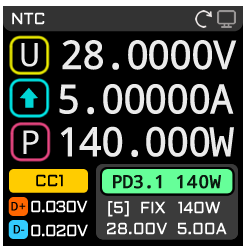
P1-2.png
1 Main Interface: Quick PDO / RDO Brief Info Box

PD3.1 140W:
  • PD3.1 indicates K2 has captured the real PD communication.
  • 140W is the maximum PD broadcast power provided by the charger.
  • Current K2 rule: regardless of SPR, EPR, PPS, or AVS, the maximum value among them is shown.


Second Line – FIX / PPS / AVS:
  • FIX: The phone is currently requesting the 5th PD profile for charging; fixed voltage level.
  • PPS: Continuously adjustable voltage within the SPR range.
  • AVS: Continuously adjustable voltage within the EPR range.
  • 140W: The actual power value currently requested by the phone.


Third Line – 28.00V 5.00A:
  • Shows the voltage and current requested by the phone for charging.
  • Note: The phone requesting this voltage/current profile does not guarantee charging at exactly this value.
  • Actual charging voltage/current is generally lower than the requested numbers.


K2 Version 2.0 and above introduces multi-protocol passive monitoring.
  • Supports listening to PD ID broadcasts from multiple well-known domestic and international charger brands.

-------------------------------------------------------------
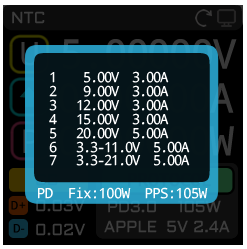
P1-3.png
Quick PDO:
When a PD-enabled charger or power bank is connected to K2,
pressing the OK button in this interface allows you to quickly view the PD charger’s broadcast information.
  • Quick PDO only displays the PD broadcast list and does not trigger high voltage.
  • Since it does not change the voltage, PD data can be read safely and quickly.

-------------------------------------------------------------
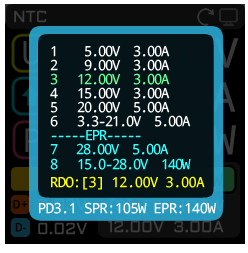

P1-4.png
Quick PDO / RDO Detailed List:
When a phone is charging via PD, the brief info box may not show complete information.
  • Press the OK button to display the detailed PD broadcast and charging request list.

Color Indicators:
  • Green: The phone has requested the 3rd PD profile from the charger.
  • Yellow (RDO): The phone’s currently requested voltage and current.

Notes:
  • The phone’s requested voltage/current may not match the PDO broadcast exactly.
  • The actual charging voltage/current may be higher, equal to, or lower than the requested values.

    • Example: The phone requests PPS 11 V 3 A, but actual charging could be 12 V 4 A. This is normal.

-------------------------------------------------------------

Quick-Charging Protocol Assisted Estimation: “Fake Protocol” Introduction
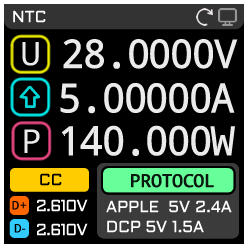
P1-5.png
Note: The fast-charging protocol shown as PROTOCOL is estimated based on the D+ and D– voltage levels and the charging voltage/current.
  • It does not represent the actual fast-charging communication protocol being used by the phone or charger.

-------------------------------------------------------------

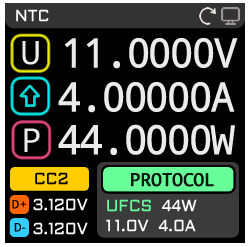
Fast-Charging Protocol Real-Time Capture: Integrates Quick-Charging UFCS and VIVO (VFC)
P1-6.png
K2 supports real-time capture of UFCS and VIVO (VFC) fast-charging protocols. It can decode charging data from both protocols in real time, displaying current voltage and current information.
  • UFCS: Green indicates data packets are being captured; red indicates communication has paused.
  • Note: After UFCS or VFC handshake, if the device stops communication but maintains the high-voltage profile, this is normal. This is commonly seen with power banks.

    • Example: A power bank requesting a fixed 11 V 4 A profile may stop communication, turning UFCS red.


Why does a 100 W charger show only 65 W on this interface when plugged directly into K2?
  • The main interface performs passive PD listening and does not actively trigger charger PD profiles.
  • Some protocol chips, if not triggered, will broadcast only low power.

    • Example: A 100 W (20 V 5 A) charger may only broadcast 65 W (20 V 3.25 A).

  • To measure the full 100 W, enter the PD trigger interface for active testing.
  • Currents above 3 A / 3.25 A generally require an Emark-equipped data cable. K2’s virtual Emark is not fully powered, so 5 A measurements require a proper Emark cable.


回复

使用道具 举报

31

主题

80

回帖

3109

积分

Administrator

积分
3109
 楼主| 发表于: 03-11-2025 07:34:02
| 显示全部楼层
P2 Capacity Statistics Interface
P2-1.png
P2 Interface: Capacity Statistics
Title Bar:
  • REC > 0.08 A: Data recording only starts when current exceeds this threshold. Most phones draw tens to over 100 mA of standby current after full charge, so a threshold is needed to accurately record capacity. Users can adjust this value by observing their phone’s standby current 30 minutes after full charge.
  • Right side “1”: Indicates data is being recorded in the first storage slot. Short press BACK to switch to the second slot.
  • Circular marker: Blinking indicates active recording.

Two Storage Slots:
  • Designed to allow users to record charging and discharging capacities separately, useful for calculating conversion efficiency.

Metrics:
  • Ah: Charging capacity
  • Wh: Charging energy
  • Left-side time: Duration of current offline recording for the selected slot

Controls:
  • Long press OK to clear capacity data.

Storage Notes:
  • K2 uses conventional EEPROM for offline capacity recording, not ultra-high-cycle ferroelectric storage like C5.
  • Most of K2’s independent storage is allocated for wear-leveling algorithms.
  • Remaining AVG and MAX values do not have enough redundant space for wear-leveling.
  • K2 provides a workaround: power-off memory for MAX and AVG data. Short press OK to record, with a lifespan of over 1 million cycles.


回复

使用道具 举报

31

主题

80

回帖

3109

积分

Administrator

积分
3109
 楼主| 发表于: 03-11-2025 07:34:53
| 显示全部楼层
P3 Ripple Detection
P3forum.png
P3: Ripple Detection Interface
  • 2 M: Sampling frequency
  • 100 kHz: Auto-tracked frequency value
  • K2 features single-frequency tracking technology.

The black triangle icon with an orange cursor below the ripple waveform indicates auto-frequency lock.
  • K2 can automatically track, lock, and calculate the waveform with the strongest spectral intensity and display its operating frequency.

Curves:
  • Curve 1 (white): Actual ripple waveform
  • Curve 2 (blue): Spectrum analysis

Ripple Curve: Reflects the amplitude of charger ripple (smaller is better).
Spectrum Curve: Reflects the frequency characteristics of the charger’s entire topology.
  • From the spectrum curve, you can observe the charger’s switching frequency distribution:
    • Standard low-power QR flyback chargers: tens of kHz
    • High-frequency GaN chargers (e.g., AHB): over 100 kHz

  • For chargers with secondary buck output: multiple strong peaks may appear in the spectrum.

Vpp: Current measured ripple value
  • Typical chargers can maintain ripple below 200 mV.

Ripple Measurement Method:
  • K2 must be placed close to the charger, directly connected.
  • Use a data cable over 1 m to connect K2 to the trigger/load.
  • Must use a professional commercial load for testing.
  • Ripple data is typically measured at 20%, 50%, and 100% load.

Note: Using a phone or power bank as the load, or testing no-load, does not measure actual ripple.
Controls:
  • Short press OK to switch sampling rates: 500 kHz, 1 MHz, 2 MHz.
  • For standard chargers, 2 MHz sampling rate is recommended.


回复

使用道具 举报

31

主题

80

回帖

3109

积分

Administrator

积分
3109
 楼主| 发表于: 03-11-2025 07:36:08
| 显示全部楼层
P4 Tools menu.
p4forum.png

回复

使用道具 举报

31

主题

80

回帖

3109

积分

Administrator

积分
3109
 楼主| 发表于: 03-11-2025 08:13:10
| 显示全部楼层
K2 Firmware Upgrade Method

Connect the HID port to a computer using a USB-C data cable.

K2up.png

First, press and hold the "DFU / -" button, then connect the USB-C port to the HID communication port.

When the DFU prompt appears on the screen, release the "DFU / -" button.


-------------------------------------------------------------


DIY Type-C external temperature probe
1. Connect the TYPE-C connector’s GND to either SBU1 or SBU2.
2. The NTC sensor wires are not polarity-sensitive.
ntc.png
NTC specification: 10kΩ (±2%) @25°C, B=3435


回复

使用道具 举报

您需要登录后才可以回帖 登录 | 注册

本版积分规则

Archive|手机版|小黑屋|AVHzY Forum

GMT-8, 07-12-2025 07:43 , Processed in 0.103719 sec., 19 queries .

Powered by Discuz! X3.5

© 2001-2025, Tencent Cloud.

快速回复 返回顶部 返回列表